
The Council anchors its documentary provenance in three records: Boone’s 1775 expedition, Bowman’s commission of December 21, 1776, and Durrett’s published account of an appointment in 1859. The route and fort records, the commission text and the essay illuminate different aspects of the title’s history.
The timeline also includes John Filson’s 1784 literary portrayal, the second Kentucky Constitution of 1799, the transatlantic stage appearance of Colonel Nimrod Wildfire in 1833, and the 1930 handbook. These records support a wider inquiry into how the title was applied, assumed, formalized and used.
Sources
- Kentucky Historical Society, “Daniel Boone’s Trace” (opens in a new tab)
Historical marker text identifies the Transylvania Company, the 1775 trail and its entry into Kentucky at Cumberland Gap.
- Kentucky Historical Society, “Fort Boonesborough” (opens in a new tab)
The marker identifies Boone with the April 1775 settlement and records the meeting convened by Richard Henderson that May.
- John Mason Brown, The Political Beginnings of Kentucky (1889), pp. 27–29 (opens in a new tab)
Reproduces the opening of the May 23, 1775 Transylvania proceedings and identifies Daniel and Squire Boone among the Boonesborough delegates. It cites Collins’ Historical Sketches of Kentucky, vol. II, p. 498 and following.
- National Governors Association, Isaac Shelby (opens in a new tab)
Biography of Kentucky’s first governor.
- National Park Service historical handbook, Patriot Commanders at Kings Mountain (opens in a new tab)
Identifies Isaac Shelby among the militia colonels who led Patriot detachments.
- Recreation.gov, “Wilderness Road Heritage Highway” (opens in a new tab)
Describes the modern byway from US 25E at the Tennessee–Kentucky line southeast of Middlesboro to US 25 at Berea.
- “Two Colonels in Kentucky,” p. 101 (opens in a new tab)
John W. Wayland, The Bowmans: A Pioneering Family in Virginia, Kentucky and the Northwest Territory (1943), chapter X. Printed p. 101 (PDF page 121) reproduces Patrick Henry’s commission to John Bowman, dated December 21, 1776 at Williamsburg. Internet Archive snapshot, July 18, 2024.
- John Filson, The Discovery, Settlement and Present State of Kentucke (1784) (opens in a new tab)
University of Nebraska–Lincoln, digital edition. See the appendix “The Adventures of Col. Daniel Boon.”
- Smithsonian Libraries, The Adventures of Colonel Daniel Boon (opens in a new tab)
The catalog traces its edition to Gilbert Imlay’s London reprinting in the third edition of A Topographical Description (1797).
- Kentucky Legislative Research Commission, The Constitutions of Kentucky (opens in a new tab)
Informational Bulletin No. 137 reproduces the first and second constitutions, dated 1792 and 1799.
- Kentucky Historical Society, 1792 Constitution, MSS145_1_22 (opens in a new tab)
Digitized manuscript dated April 19, 1792. The text provides for the new government to begin June 1.
- The Lion of the West, Study Guide and Play Text (opens in a new tab)
ERIC ED236723, “Early Reviews,” reproduces the April 13, 1833 Morning Courier account quoting The Times on Hackett at Covent Garden. The guide also covers the American play and its revisions.
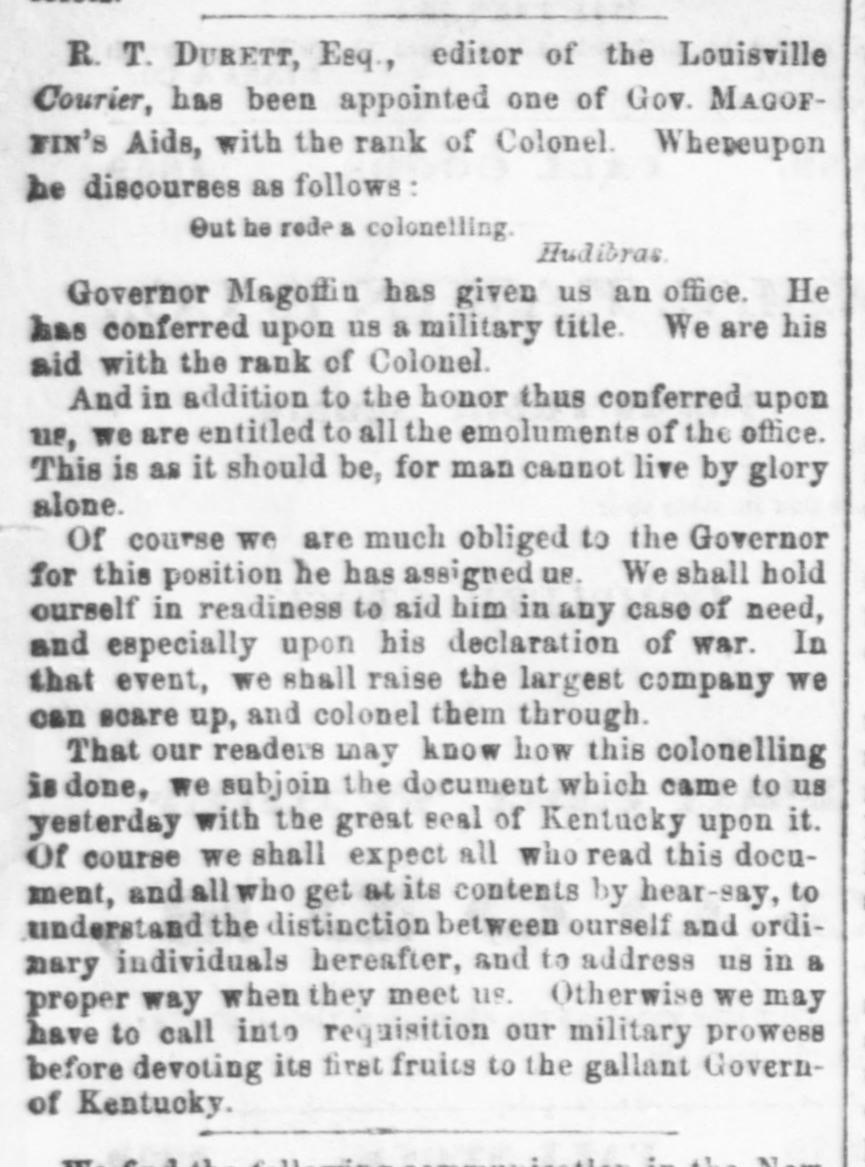
- R. T. Durrett, on his appointment by Governor Magoffin
Louisville Courier excerpt reprinted in Nashville Union and American, September 9, 1859. Supplied clipping. Page and column await confirmation.
- Opie Read, A Kentucky Colonel (1890), The Huntington, call no. 152446 (opens in a new tab)
Rare-book catalog record for the 1890 novel.
- American Film Institute Catalog, The Kentucky Colonel (1920) (opens in a new tab)
Credits Opie Read’s 1890 novel as the literary source and gives September 26, 1920 as the release date.
- Oliver Vickery and John E. Goddard, eds., The Kentucky Colonels Handbook
Kentucky Colonels Directory, Brown Hotel, Louisville, 1930. The title and copyright leaves are the first two pages of the historical scan.