
Follow dated records of frontier leadership, militia appointments, literary and theatrical portrayals, gubernatorial recognition, and public uses of the name. The entries identify what each source records.
The Council used its 2025 declaration and research appendices as finding aids. The entries cite underlying records where available. Items marked as research leads, press transcripts, or later recollections have specific limits described in the entry.
Frontier, Militia, and Statehood
Boone’s Party Blazes the Wilderness Road
Frontier record
Daniel Boone led the Transylvania Company’s road party through Cumberland Gap. The historical marker dates the expedition to 1775. A contemporary instrument commissioning Boone as colonel that March remains to be located.
- Kentucky Historical Society, “Daniel Boone’s Trace” (opens in a new tab)Historical marker text identifies the Transylvania Company, the 1775 trail and its entry into Kentucky at Cumberland Gap.
- Robert F. Collins, A History of the Daniel Boone National Forest, 1770–1970 (opens in a new tab)U.S. Forest Service history, edited by Betty B. Ellison, digitized by the Forest History Society. See the account of the Transylvania Company and Boone’s road party.
Delegates Meet at Boonesborough
Convention record
Richard Henderson opened the Transylvania delegates’ meeting. The published journal calls Henderson and chair Thomas Slaughter colonels, and identifies Boone through the Boonesborough delegation. The meeting belongs to the company settlement’s political history.
- John Mason Brown, The Political Beginnings of Kentucky (1889), pp. 27–29 (opens in a new tab)Reproduces the opening of the May 23, 1775 Transylvania proceedings and identifies Daniel and Squire Boone among the Boonesborough delegates. It cites Collins’ Historical Sketches of Kentucky, vol. II, p. 498 and following.
- Kentucky Historical Society, “Fort Boonesborough” (opens in a new tab)The marker identifies Boone with the April 1775 settlement and records the meeting convened by Richard Henderson that May.
Patrick Henry Commissions John Bowman
Militia commission
The surviving published text commissions Bowman as colonel of the militia for Kentucky County, Virginia. It identifies the issuer, jurisdiction, and duties of the appointment.
- “Two Colonels in Kentucky,” p. 101 (opens in a new tab)John W. Wayland, The Bowmans: A Pioneering Family in Virginia, Kentucky and the Northwest Territory (1943), chapter X. Printed p. 101 (PDF page 121) reproduces Patrick Henry’s commission to John Bowman, dated December 21, 1776 at Williamsburg. Internet Archive snapshot, July 18, 2024.
- Military History of Kentucky (opens in a new tab)Kentucky Adjutant General’s report (1939), Revolutionary War section. Gives Bowman’s commission date as December 21, 1776.
John Filson Publishes Colonel Boone’s Adventures
Literary record
After meeting Boone in Kentucky, Filson published his frontier narrative as an appendix to The Discovery, Settlement and Present State of Kentucke. The printed title documents how Filson presented Boone to readers.
- John Filson, The Discovery, Settlement and Present State of Kentucke (1784) (opens in a new tab)University of Nebraska–Lincoln, digital edition. See the appendix “The Adventures of Col. Daniel Boon.”
- The Filson Historical Society, John Filson Publishes His History of Kentucky (opens in a new tab)The society dates Filson’s arrival in Kentucky to 1783 and records that he encountered and interviewed Boone there.
- The Filson Historical Society, 1784 Title Page (opens in a new tab)The original Delaware edition’s title page names the Boone narrative and the book’s other appendices.
Kentucky Enters the Union
Constitutional record
Kentucky’s first constitution was completed in April. State government began on June 1, moving Kentucky from Virginia’s jurisdiction to statehood.
- Kentucky Historical Society, 1792 Constitution, MSS145_1_22 (opens in a new tab)Digitized manuscript dated April 19, 1792. The text provides for the new government to begin June 1.
- Kentucky Legislative Research Commission, The Constitutions of Kentucky (opens in a new tab)Informational Bulletin No. 137 reproduces the first and second constitutions, dated 1792 and 1799.
Boone’s Narrative Appears in a London Edition
Publication record
Gilbert Imlay’s third edition included a London reprinting of the Boone narrative. This is a dated record of its circulation abroad.
- Smithsonian Libraries, The Adventures of Colonel Daniel Boon (opens in a new tab)The catalog traces its edition to Gilbert Imlay’s London reprinting in the third edition of A Topographical Description (1797).
Kentucky Adopts Its Second Constitution
Constitutional record
The Council uses this constitutional change as the boundary between Old Kentucky and New Kentucky, beginning in 1800. The boundary is an editorial convention for the chronology.
- Kentucky Legislative Research Commission, The Constitutions of Kentucky (opens in a new tab)Informational Bulletin No. 137 reproduces the first and second constitutions, dated 1792 and 1799.
- University of Kentucky, Kentucky Constitutional Conventions (opens in a new tab)Digital collection includes the journal of proceedings for the convention at Frankfort in 1799.
Military Service, Stage, and Press
Johnson and Todd in the War of 1812
Military record
Richard Mentor Johnson commanded Kentucky Volunteers against the British in 1813. Charles Stewart Todd’s military biography documents his wartime service. A separate honorary appointment for Todd by Governor Shelby would require its own dated record.
- U.S. House of Representatives, Biographical Directory, Richard Mentor Johnson (opens in a new tab)The biographical entry records his commission as colonel of Kentucky Volunteers, his service in 1813 and his later vice presidency.
- The Filson History Quarterly, “An Unexpected Nightmare,” pp. 383–385 (opens in a new tab)Independent biographical account of Todd’s military service and early career, with references to the Todd papers.
- Kentucky Secretary of State, Executive Journal (opens in a new tab)Repository lead for researching gubernatorial acts. The original Todd instrument is a target for verification.
Nimrod Wildfire Appears on the American Stage
Theatrical record
An April 27 New York review records James Kirke Paulding’s The Lion of the West. James H. Hackett played the fictional frontier colonel whom later accounts associated with Davy Crockett.
- The Lion of the West, Study Guide and Play Text (opens in a new tab)ERIC ED236723, “Early Reviews,” reproduces the April 13, 1833 Morning Courier account quoting The Times on Hackett at Covent Garden. The guide also covers the American play and its revisions.
- American Antiquarian Society, Proceedings, p. 228 (opens in a new tab)Discusses the Crockett association and a performance at which Crockett and the actor playing Colonel Nimrod Wildfire exchanged bows.
Wildfire Reaches Covent Garden
Theatrical record
Hackett brought the character to London in The Kentuckian. Appendix B, pp. 31–33, identifies March 10 and 11 London reviews for checking early printed uses of Kentucky Colonel. The performance is documented; priority for the exact phrase remains open.
- The Lion of the West, Study Guide and Play Text (opens in a new tab)ERIC ED236723, “Early Reviews,” reproduces the April 13, 1833 Morning Courier account quoting The Times on Hackett at Covent Garden. The guide also covers the American play and its revisions.
A Newspaper Calls a Lawyer “the Kentucky Colonel”
Period press
The Adams Sentinel reprinted a courtroom anecdote from the New Orleans Crescent. The wording shows the designation being applied to a lawyer in print. The account gives no dated commission for the man it describes.
- “Wouldn’t Tell her Age” (opens in a new tab)The Adams Sentinel, June 20, 1859, reprinting the New Orleans Crescent. The clipping calls a lawyer “the Kentucky Colonel.”
Durrett Writes About the Honor of His Appointment
Period press
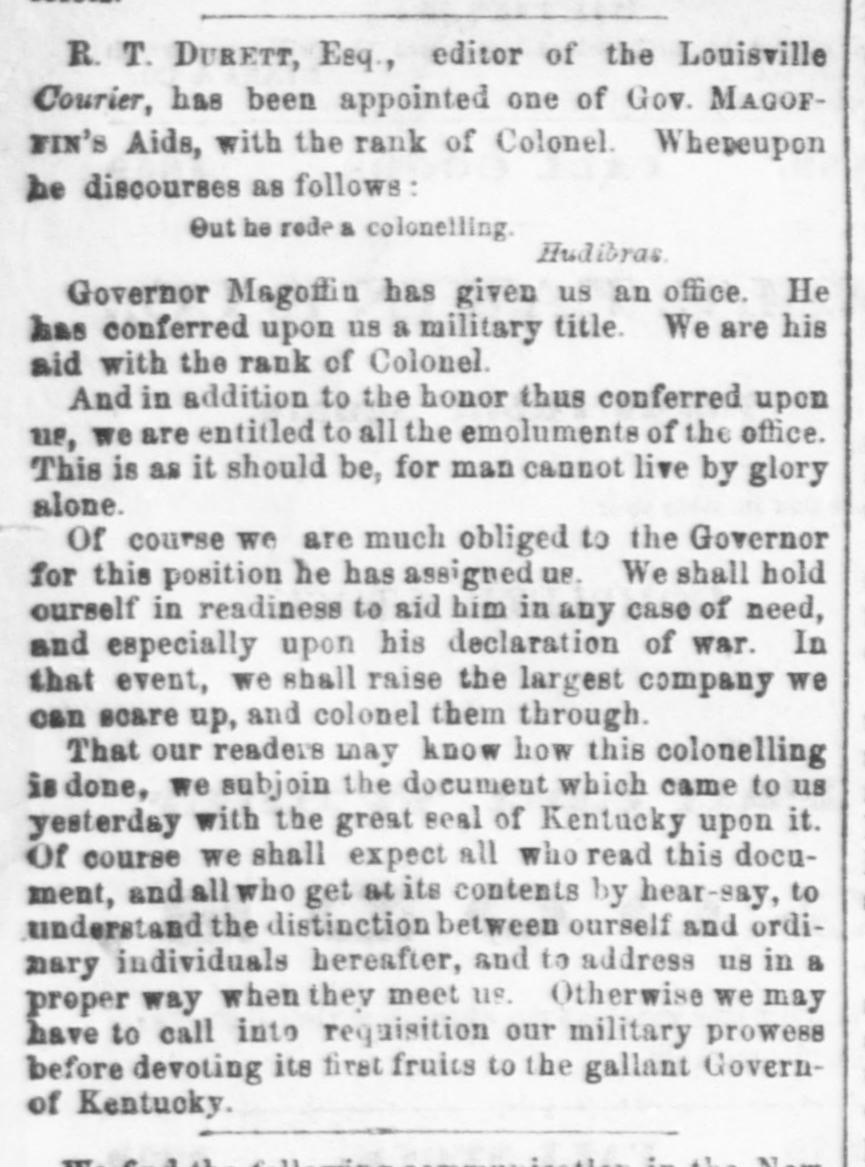
The Nashville Union and American reprinted Louisville editor Reuben T. Durrett’s response to Governor Beriah Magoffin appointing him as an aide with the rank of colonel. Durrett used Hudibras to frame his satire on the honor, rank, and social deference.
- R. T. Durrett, on his appointment by Governor MagoffinLouisville Courier excerpt reprinted in Nashville Union and American, September 9, 1859. Supplied clipping. Page and column await confirmation.
A Railway Guide Advertises a Kentucky Colonel Story
Period press
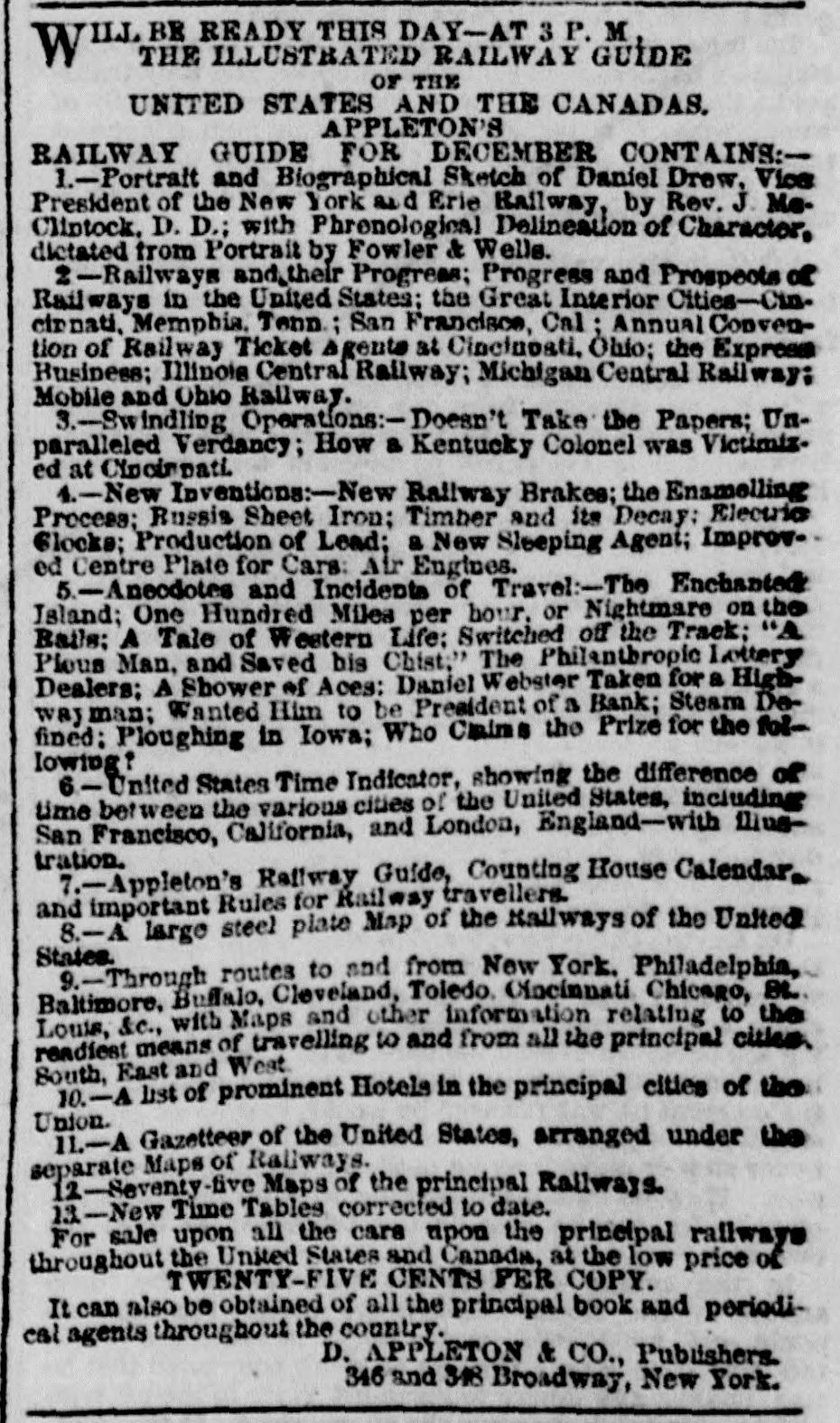
The New York Herald advertisement for Appleton’s Railway Guide uses the designation to introduce a story about a swindle in Cincinnati. The notice records another public use that year.
- D. Appleton & Co., advertisement for Appleton’s Railway GuideThe New York Herald, December 1, 1859, p. 7, item 3. Lists a story about how a Kentucky colonel was victimized at Cincinnati.
Books, Film, and Associations
Durrett Helps Found the Filson Club
Institutional history
Durrett and nine other Kentuckians founded the Louisville historical society named for John Filson. Durrett’s role connects the preservation of Kentucky’s pioneer records to the earlier author who published Boone’s account.
- The Filson Historical Society, “Filson Club Founded” (opens in a new tab)Dates the Louisville meeting to May 15, 1884 and identifies Reuben T. Durrett as the founding president.
- John Filson, The Discovery, Settlement and Present State of Kentucke (1784) (opens in a new tab)University of Nebraska–Lincoln, digital edition. See the appendix “The Adventures of Col. Daniel Boon.”
Opie Read Publishes A Kentucky Colonel
Literary record
Read made the designation the title of a novel. The Huntington catalogs an 1890 edition, giving a firm book publication date.
- Opie Read, A Kentucky Colonel (1890), The Huntington, call no. 152446 (opens in a new tab)Rare-book catalog record for the 1890 novel.
Bemis Proposes a County Militia Origin
Later interpretation
Writing in 1893, Edward W. Bemis connected the name to Kentucky’s county militia offices. His footnote records an early historical explanation. Bowman’s commission supplies separate contemporary evidence of an actual county appointment.
- Edward W. Bemis, Local Government in the South and the Southwest (1893), p. 69 (opens in a new tab)Digitized Johns Hopkins Press study. See “Local Government in Kentucky” and the footnote proposing a county militia origin.
- “Two Colonels in Kentucky,” p. 101 (opens in a new tab)John W. Wayland, The Bowmans: A Pioneering Family in Virginia, Kentucky and the Northwest Territory (1943), chapter X. Printed p. 101 (PDF page 121) reproduces Patrick Henry’s commission to John Bowman, dated December 21, 1776 at Williamsburg. Internet Archive snapshot, July 18, 2024.
The Kentucky Colonel Reaches Silent Film
Film record
The American Film Institute records the national release of William A. Seiter’s adaptation of Opie Read’s novel.
- American Film Institute Catalog, The Kentucky Colonel (1920) (opens in a new tab)Credits Opie Read’s 1890 novel as the literary source and gives September 26, 1920 as the release date.
- Opie Read, A Kentucky Colonel (1890), The Huntington, call no. 152446 (opens in a new tab)Rare-book catalog record for the 1890 novel.
Legion Reporting Uses the Title Two Ways
Period press
The American Legion Monthly’s Louisville convention report described Admiral Hugh Rodman as a Kentucky colonel and compared General Peyton C. March’s appearance to one. The passage records both personal designation and a familiar public type.
- The American Legion Monthly, December 1929, vol. 7, no. 6 (opens in a new tab)Digitized convention report, scan opening at p. 18. Appendix B, p. 6, reproduces the passage about Peyton C. March and Hugh Rodman.
The Kentucky Colonels Handbook Appears
Publication record
The Kentucky Colonels Directory at Louisville’s Brown Hotel compiled the handbook. The title and copyright leaves identify the publication and its editors, Oliver Vickery and John E. Goddard.
- Oliver Vickery and John E. Goddard, eds., The Kentucky Colonels HandbookKentucky Colonels Directory, Brown Hotel, Louisville, 1930. The title and copyright leaves are the first two pages of the historical scan.
- Kentucky Colonels. Records, 1930–1933 (opens in a new tab)The Filson Historical Society, manuscripts finding aid.
Fortune Reports on the Kentucky Colonels’ Association
Press transcript
Appendix B, p. 5, transcribes an August 1931 Fortune item, vol. 4, p. 14, describing the Louisville association as a response to numerous staff appointments. Check the original issue for the wording and use the Filson finding aid to locate the association’s own records.
- Kentucky Colonels. Records, 1930–1933 (opens in a new tab)The Filson Historical Society, manuscripts finding aid.
Anna Bell Ward Later Recalls Organizing in 1932
Later recollection
A 1976 newspaper account attributes a December 1932 organizing meeting to Ward’s recollection. The quoted recollection and the September 1933 announcements are evidence from different dates.
- The Journal News, “Kentucky Colonel Commission Marks Its 163rd Year” (opens in a new tab)Hamilton, Ohio, January 17, 1976. The article recounts a group-commissioning story and quotes the order’s first secretary about its later organization.
Newspapers Report a New Order
Period press
The Lexington Herald reported headquarters openings in New York and Lexington. The Messenger-Inquirer and Cincinnati Enquirer distinguished the newly reported order from the existing Louisville association. The reports date the public announcements.
- “The Honorable Order of Kentucky Colonels” Opens Headquarters in New York City and in Lexington (opens in a new tab)The Lexington Herald, September 21, 1933. Contemporary coverage of the opening of the two headquarters.
- “New Colonels Body Is Formed” (opens in a new tab)Associated Press, Messenger-Inquirer, September 29, 1933. Reports the new order and separately identifies the existing Louisville association.
- “Kentucky Ku’nels Organize” (opens in a new tab)The Cincinnati Enquirer, September 27, 1933. A contemporary report distinguishing the two groups.
Public Memory and Modern Uses
Congressional Record Lead for Edward W. Creal
Research lead
Appendix E, p. 11, attributes remarks about the title to Kentucky Representative Edward W. Creal. The date points to the bound House proceedings. The exact printed page and wording remain to be checked.
- U.S. Government Publishing Office, Congressional Record, vol. 80, pt. 5 (opens in a new tab)Bound volume covering April 1–21, 1936. The exhibit index points to April 2; the printed page for the attributed Creal remarks remains to be confirmed.
Kentucky’s Flood Relief Leaves an Archival Record
Agency and archival records
Kentucky National Guard accounts, American Red Cross correspondence, and American Legion post records identify organizations involved in the Ohio River flood response. They establish who did particular work.
- Kentucky National Guard, The Kentucky National Guard to the Rescue (opens in a new tab)Historical account of the Guard’s 1937 flood response, based in part on official reports and expenditures.
- The Filson Historical Society, Records of the 1937 Flood (opens in a new tab)Archival documents include American Red Cross correspondence from the 1937 Ohio and Mississippi Valley flood response.
- The Filson Historical Society, American Legion Jefferson Post No. 15 Records (opens in a new tab)The manuscript finding aid identifies records of the Louisville post’s work during the 1937 flood.
A Banquet Program Is Cited for the Todd Origin Story
Research lead
Appendix E, pp. 8 and 15, identifies a 1941 Derby Eve program as a source for the story of Todd and Governor Shelby. The original program and page are needed to confirm its wording and publication history.
- The Filson History Quarterly, “An Unexpected Nightmare,” pp. 383–385 (opens in a new tab)Independent biographical account of Todd’s military service and early career, with references to the Todd papers.
A Journal Studies the Meaning of Kentucky Colonel
Published interpretation
American Notes and Queries treated Kentucky Colonel as a subject of literary and linguistic study. The article is a later interpretation of how the expression circulated.
- American Notes and Queries, “The Kentucky Colonel: A Study in Semantics,” April 1947 (opens in a new tab)Vol. 7, no. 1. Appendix A, pp. 12–13, identifies this article and points to the digitized issue.
- 1950s
Harland Sanders Gives the Title a Public Face
Biographical and material records
After receiving a Kentucky Colonel commission, Sanders adopted the white suit and string tie that became part of his public identity. The Smithsonian’s weathervane documents the use of his likeness in restaurant advertising.
- Indiana Historical Bureau, “Colonel” Harland Sanders, 1890–1980 (opens in a new tab)Historical marker and source notes on Sanders’s commission, public persona, restaurant business, and later career.
- Smithsonian Institution, Colonel Sanders Weathervane (opens in a new tab)National Museum of American History. A restaurant artifact documenting the use of Sanders’s image and title in advertising.
George M. Chinn Leads the Kentucky Historical Society
Biographical record
The retired Marine colonel became director of the Kentucky Historical Society in 1960. He wrote about Kentucky’s pioneer and local history.
- Centre College, George M. Chinn (opens in a new tab)CentreCyclopedia biography of the Marine colonel, Kentucky historian, and former Kentucky Historical Society director.
The Kentucky Colonels Release Appalachian Swing!
Music record
The Kentucky Colonels used the name as a bluegrass band. The Smithsonian preserves archival material identifying the group and musicians Roland and Clarence White.
- Smithsonian Institution, Ralph Rinzler Folklife Archives, Appalachian Swing (opens in a new tab)The archival record identifies Kentucky Colonels tracks and performers Roland White and Clarence White.
- MusicBrainz, Appalachian Swing! (opens in a new tab)Release catalog dates the Kentucky Colonels album to 1964 and identifies World Pacific Records as label.
The Kentucky Colonels Win the ABA Championship
Sports record
Louisville’s professional team used the name Kentucky Colonels. It defeated the Indiana Pacers in the 1975 American Basketball Association finals.
- The Lexington Herald-Leader, Dan Issel Recalls the 1975 ABA Championship (opens in a new tab)Mark Story’s retrospective records Kentucky’s series win over the Indiana Pacers.
A Newspaper Repeats a Different Shelby Story
Period press
The Journal News recounted a group-commissioning version involving Shelby and men who fought in the War of 1812. It documents what was being told in 1976. The story and the original commissioning record are separate evidence questions.
- The Journal News, “Kentucky Colonel Commission Marks Its 163rd Year” (opens in a new tab)Hamilton, Ohio, January 17, 1976. The article recounts a group-commissioning story and quotes the order’s first secretary about its later organization.
- “Two Colonels in Kentucky,” p. 101 (opens in a new tab)John W. Wayland, The Bowmans: A Pioneering Family in Virginia, Kentucky and the Northwest Territory (1943), chapter X. Printed p. 101 (PDF page 121) reproduces Patrick Henry’s commission to John Bowman, dated December 21, 1776 at Williamsburg. Internet Archive snapshot, July 18, 2024.
- Today
The Governor Receives Nominations for the Honor
Current guidance
Kentucky’s Governor’s Office describes the Kentucky Colonel as the Commonwealth’s highest honor and publishes its nomination process.
- Office of the Governor of Kentucky, Kentucky Colonels (opens in a new tab)The Commonwealth’s account of the modern honor and its nomination process.