Colonel Harland Sanders
Sanders made the Kentucky Colonel internationally recognizable. He turned his commission and signature public style into a personal identity known around the world.
Kentucky Colonel Council
This knowledge base begins in 1775 with Colonel Daniel Boone when he was commissioned to build the Wilderness Road with 33 axmen designating John Bowman as his lieutenant colonel. Boone’s party under the authority of the Transylvania Company Charter (North Carolina) blazed a frontier trail through Cumberland Gap from the Virginia side of the Alleghenies into Kentucky and onward to Boonesborough where together they formed the first manly government on the southern bank of the Kentucky River.
Over the next 17 years history was made during and after the American Revolution as thousands followed including dozens of colonels with land warrants leading to the establishment of the Commonwealth of Kentucky. Today Kentucky stands out as the only state established and founded exclusively by colonels and the pioneers they led.

Boone’s expedition in 1775, Bowman’s commission in 1776, and Durrett’s account in 1859 anchor a wider history of the title in records, literature, and public life.
Boone’s party marked the route through Cumberland Gap into Kentucky for the Transylvania Company. The Boonesborough marker records the April settlement.
Patrick Henry commissioned Bowman as a militia colonel for Kentucky County on December 21. The published instrument identifies the issuer, rank and duties.
Filson made Boone a figure of early Americana in his published account of Colonel Daniel Boon. The narrative later appeared in London.
Kentucky’s first constitution dates the beginning of the new Commonwealth government to June 1.
The Commonwealth adopted a second constitution. The Council uses it as the boundary between Old Kentucky and New Kentucky, beginning in 1800.
James H. Hackett brought a fictional Kentucky colonel associated with the Crockett persona to the London stage.
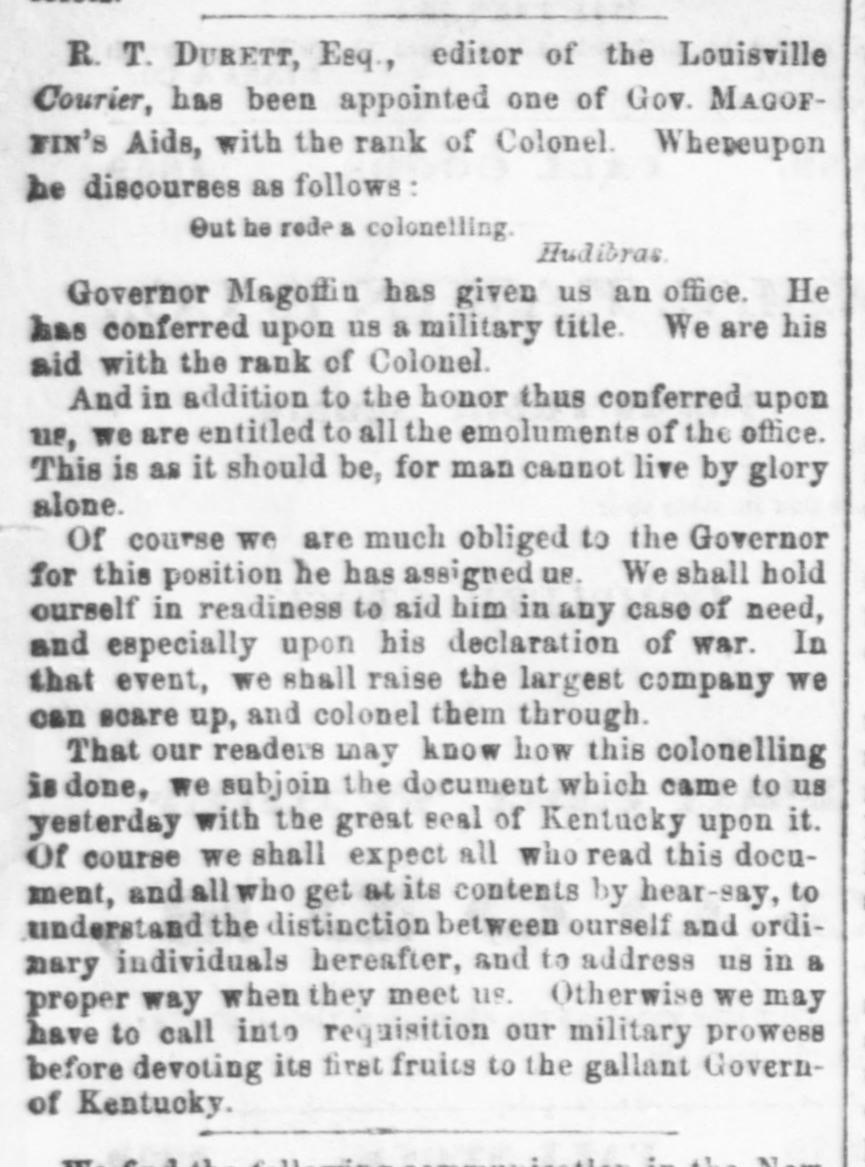
Durrett used Hudibras to frame his appointment as an aide with the rank of colonel and to reflect on the honor it brought.
Opie Read made the designation the title of his novel.
A silent film adapted Read’s novel for the screen.
The handbook compiled at Louisville’s Brown Hotel brings together essays and a directory of Kentucky Colonels.
Who bore the title, and who used it to describe them? What did it mean in that setting? Where and when did it appear, how did it come into use, and why did it matter to the person’s public life?
A commission records an appointment. A newspaper may apply “Kentucky Colonel” as an exonym, a designation given by others. Fiction and the stage show how readers and audiences came to recognize the figure.
Nashville Union and American, September 9, 1859.
Sanders made the Kentucky Colonel internationally recognizable. He turned his commission and signature public style into a personal identity known around the world.
The Maverick was a Kentucky Colonel, a Marine colonel and director of the Kentucky Historical Society. His work on Kentucky’s pioneer legacies and local history helps place the title in its historical setting starting in 1775, not 1813.
The Governor’s Office describes the Kentucky Colonel as the Commonwealth’s highest honor, awarded for contributions to the community, state or nation and for special achievements. Donations, fundraising and membership in private organizations are voluntary.
Compare the historical markers, the surviving commission text, early editions, the 1859 clippings and the 1930 handbook.
Historical marker text identifies the Transylvania Company, the 1775 trail and its entry into Kentucky at Cumberland Gap.
The marker identifies Boone with the April 1775 settlement and records the meeting convened by Richard Henderson that May.
Reproduces the opening of the May 23, 1775 Transylvania proceedings and identifies Daniel and Squire Boone among the Boonesborough delegates. It cites Collins’ Historical Sketches of Kentucky, vol. II, p. 498 and following.
Biography of Kentucky’s first governor.
Identifies Isaac Shelby among the militia colonels who led Patriot detachments.
Describes the modern byway from US 25E at the Tennessee–Kentucky line southeast of Middlesboro to US 25 at Berea.
John W. Wayland, The Bowmans: A Pioneering Family in Virginia, Kentucky and the Northwest Territory (1943), chapter X. Printed p. 101 (PDF page 121) reproduces Patrick Henry’s commission to John Bowman, dated December 21, 1776 at Williamsburg. Internet Archive snapshot, July 18, 2024.
University of Nebraska–Lincoln, digital edition. See the appendix “The Adventures of Col. Daniel Boon.”
The catalog traces its edition to Gilbert Imlay’s London reprinting in the third edition of A Topographical Description (1797).
Informational Bulletin No. 137 reproduces the first and second constitutions, dated 1792 and 1799.
Digitized manuscript dated April 19, 1792. The text provides for the new government to begin June 1.
ERIC ED236723, “Early Reviews,” reproduces the April 13, 1833 Morning Courier account quoting The Times on Hackett at Covent Garden. The guide also covers the American play and its revisions.
Louisville Courier excerpt reprinted in Nashville Union and American, September 9, 1859. Supplied clipping. Page and column await confirmation.
Rare-book catalog record for the 1890 novel.
Credits Opie Read’s 1890 novel as the literary source and gives September 26, 1920 as the release date.
Kentucky Colonels Directory, Brown Hotel, Louisville, 1930. The title and copyright leaves are the first two pages of the historical scan.
The Commonwealth’s account of the modern honor and its nomination process.
Historical marker and source notes on Sanders’s commission, public persona, restaurant business, and later career.
National Museum of American History. A restaurant artifact documenting the use of Sanders’s image and title in advertising.
CentreCyclopedia biography of the Marine colonel, Kentucky historian, and former Kentucky Historical Society director.