
Start with six questions. Who bore or used the title? What wording did the record use? Where did it appear? How did the designation arise? Why did the bearer or someone else use it? When can the use first be dated?
An exonym is a name applied by others. Here that can mean a newspaper, audience or community calling a person a Kentucky Colonel. An externally applied designation, a self-adopted style, a stage character and a dated commission all belong in the research, with the type of evidence stated for each.
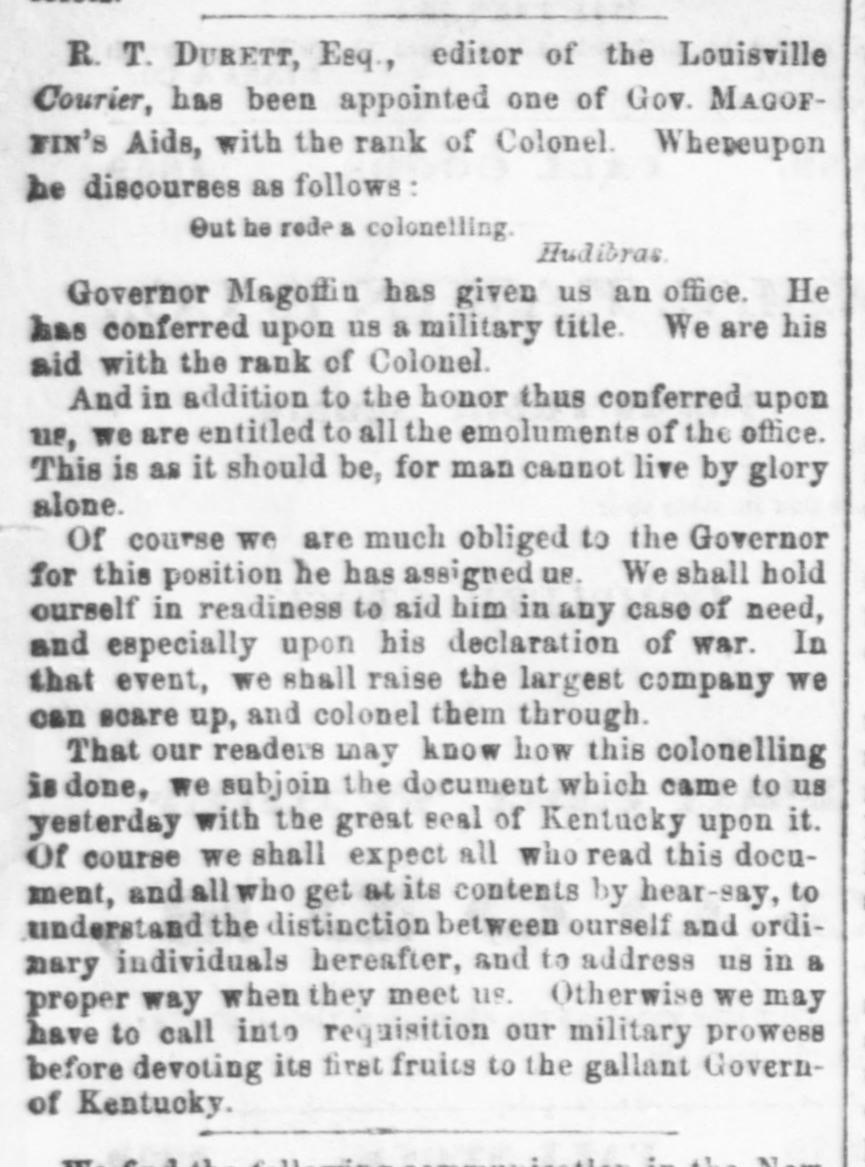
The June 1859 courtroom anecdote illustrates externally applied usage. Durrett’s September essay illustrates first-person treatment of the dignity and status attached to an appointment. The 1930 handbook records how an organized community of recipients presented itself in print.
The Governor’s Office describes the Kentucky Colonel commission as recognition for contributions and achievements. Its published nomination guidance imposes no duty to donate, fundraise, or join a private association. Those activities are individual choices.
Sources
- “Wouldn’t Tell her Age” (opens in a new tab)
The Adams Sentinel, June 20, 1859, reprinting the New Orleans Crescent. The clipping calls a lawyer “the Kentucky Colonel.”
- R. T. Durrett, on his appointment by Governor Magoffin
Louisville Courier excerpt reprinted in Nashville Union and American, September 9, 1859. Supplied clipping. Page and column await confirmation.
- Oliver Vickery and John E. Goddard, eds., The Kentucky Colonels Handbook
Kentucky Colonels Directory, Brown Hotel, Louisville, 1930. The title and copyright leaves are the first two pages of the historical scan.
- Office of the Governor of Kentucky, Kentucky Colonels (opens in a new tab)
The Commonwealth’s account of the modern honor and its nomination process.